Museums Near Possum Kingdom Lake

Contributing Author: Mattison Allen

  • Possum Kingdom Lake offers plenty of educational museums:
    • National Vietnam War Museum
    • Museum of the Americas
    • The Old Post Office Museum and Art Center
    • Fort Belknap

Possum Kingdom Lake, and neighboring counties, are enshrouded in history. Luckily, there are plenty of museums in the Possum Kingdom area to enrich and educate yourself about local and national history.

National Vietnam War Museum

The National Vietnam War Museum is part of the National Vietnam War Museum Project that started in 1998. Designed to tell an unbiased account, the museum was formed to promote an understanding of the Vietnam Era while honoring the servicemen and women who served. The museum is free to visit and accepts financial donations. 

The exhibits, including The History of Fort Wolters, My Faithful Warrior, and The Contemplation Garden, are worth the hour-and-a-half drive from Possum Kingdom Lake. Each of these is dedicated to a different area of service in the war. From the helicopter training to the service dogs, it’s all a powerful reminder of the impact of war. In addition, visitors can expect temporary exhibits throughout the year, so you’ll have something new to learn each time you go.

Address: 12685 Mineral Wells Hwy., Weatherford, TX 76086

Hours:

  • Monday: Closed
  • Tuesday: Closed
  • Wednesday: 9 a.m. – 5 p.m.
  • Thursday: 9 a.m. – 5 p.m.
  • Friday: 9 a.m. – 5 p.m.
  • Saturday: 9 a.m. – 5 p.m.
  • Sunday: 9 a.m. – 5 p.m.

https://www.nationalvnwarmuseum.org/

Museum of the Americas

The Museum of the Americas displays the heritage of the indigenous peoples of the Americas. This museum is free to visit and explicitly highlights the late 10th and 20th centuries. You can see exhibits about Native America, Mexico, the Caribbean, Central America, and South America. 

This museum is unique to the area because it also has an exhibit featuring the Texas Indian Reservations, of which there are three in the Lone Star State. The entire section is dedicated to these people, their artifacts, and pre-historic pieces. 

The Museum of the Americas is consistently opening new exhibits, so you’ll be able to see something new each time you visit the museum. If you’re looking to dive into the history of some of the first inhabitants of this land, The Museum of the Americas would be the perfect place to start, just an hour and a half from Possum Kingdom Lake.

Address: 216 Fort Worth Hwy., Weatherford, TX 76086

Hours:

  • Monday: Closed
  • Tuesday: Closed
  • Wednesday: 10 a.m. – 4 p.m.
  • Thursday: 10 a.m. – 4 p.m.
  • Friday: 10 a.m. – 4 p.m.
  • Saturday: 10 a.m. – 3 p.m.
  • Sunday: Closed

http://www.museumoftheamericas.com/

The Old Post Office Museum and Art Center

In 2002, the Graham post office was transformed into a museum and art center in partnership with the Texas Cattle Raiser’s Association. It was initially built in 1936 and moved locations multiple times until it was purchased by the City of Graham in 1993. 

In the foyer, a mural by Alexandre Hogue, in the original sienna porcelain tile, welcomes you into the museum’s rich history. In addition, the art center has rotating exhibits and art displays. Not just committed to the past, it hosts National Art Shows and displays projects from the local junior high school’s science fair. Additionally, a portion of the art center is dedicated to historical artifacts from the city of Graham. The facility is located just 45 minutes north of Possum Kingdom Lake, and admission to the museum is free.

Address: 510 Third Street, Graham, TX 76450

Hours:

  • Monday: Closed
  • Tuesday: Closed
  • Wednesday: 10 a.m. – 4 p.m.
  • Thursday: 10 a.m. – 4 p.m.
  • Friday: 10 a.m. – 4 p.m.
  • Saturday: 10 a.m. – 3 p.m.
  • Sunday: Closed

https://www.opomac.net/index.html

Fort Belknap

Two actors with a cannon.
Courtesy of Visit Graham Texas

Established in 1851, Fort Belknap played a significant role during the mid-19th-century portion of the American Indian Wars. It was built to protect the Texas frontier as it sat at the northern anchor of U.S. Army forts that stretched from the Red River to the Rio Grande. Forced abandoned the fort in 1859. 

Today, Fort Belknap is designated a historic site by the Texas Historical Commission. It has a fascinating museum where visitors can wander through reconstructed buildings. The museum offers various exhibits and artifacts from the fort’s operations as well as a deeper understanding of Texas history. Only an hour north of Possum Kingdom Lake, Fort Belknap offers a place where visitors can take in the rich history that occurred so close to home for free.

Address: 114 Fort Cir., Newcastle, TX 76372

Hours:

  • Monday: 9 a.m. – 12 p.m., 1:30 p.m. – 5 p.m.
  • Tuesday: 9 a.m. – 12 p.m., 1:30 p.m. – 5 p.m.
  • Wednesday: Closed
  • Thursday: 9 a.m. – 12 p.m., 1:30 p.m. – 5 p.m.
  • Friday: 9 a.m. – 12 p.m., 1:30 p.m. – 5 p.m.
  • Saturday: 9 a.m. – 12 p.m., 1:30 p.m. – 5 p.m.
  • Sunday: 1:30 – 5 p.m.

https://visitgrahamtexas.com/things-to-do/fort-belknap/

Possum Kingdom Lake and its surrounding area brim with history. From the origins of the land around the lake to an in-depth look into national events, there is a vast wealth of exciting resources for both residents and visitors. Whether you take a trip to the National Vietnam Museum, the Museum of the Americas, The Old Post Office Museum and Art Center, or Fort Belknap, you will always learn something new.

Frequently Asked Questions

The National Vietnam War Museum Project is an initiative that started in 1998 with the goal of establishing the National Vietnam War Museum. It aims to promote an understanding of the Vietnam Era while honoring the servicemen and women who served during that time.

At the Museum of the Americas, visitors can see artifacts from Native America, the Caribbean, Central America, and South America.

The Old Post Office was built in 1936 in Graham, Texas.

Fort Belknap is designated as a historic site by the Texas Historical Commission due to its significant role in the mid-19th-century American Indian Wars and its contribution to Texas history.

The Texas frontier was guarded by a series of forts stretching from the Red River to the Rio Grande.
Palo Pinto Mountains State Park: A Texas Escape

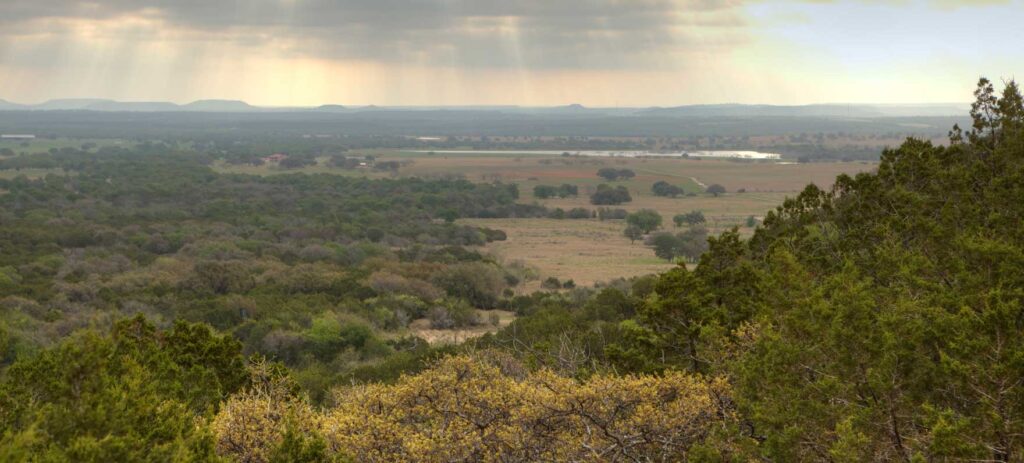
A wide shot of Palo Pinto Mountains State Park.
trees, sunlight, hills
Courtesy of TPW
  • Palo Pinto Mountains will be Texas’ 90th State Park and is expected to open in 2023:
    • About the Property
    • Tucker Lake
    • Amenities
    • When will it be ready?

Monitored and administrated by Texas Parks & Wildlife, Palo Pinto Mountains will be Texas’ 90th state park — the first in 25 years. A little over an hour from Possum Kingdom Lake, the park is the perfect escape from urban expansion. From sprawling prairies to a placid, mirror-smooth lake, Palo Pinto Mountains State Park defines the modern outdoors.

About the Property

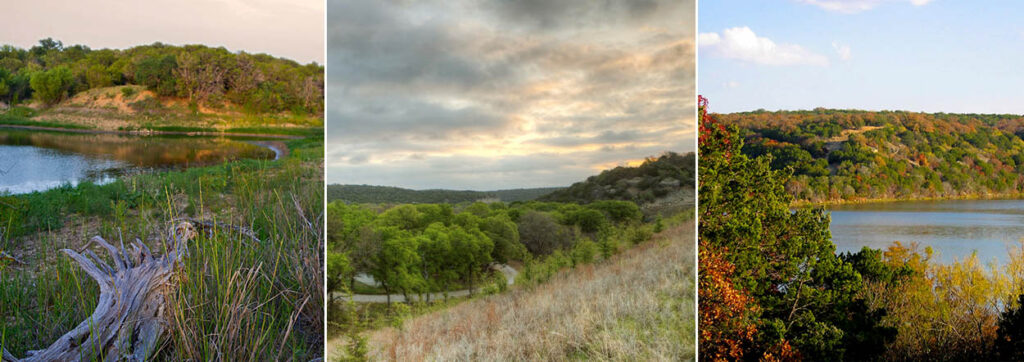
Three photos of the Palo Pinto Mountains State Park
Courtesy of TPW

Palo Pinto Mountains State Park rests at a crossroads 75 miles between Fort Worth and Abilene, and Mineral Wells is a brief 40-minute drive away. Within the 4871-acre property are rolling hills, deep ravines, sky-high ridges, wide-open grassy prairies, and striking mesas. Despite that almost 90 percent of Texans now live in urban locations, this welcome natural paradise expects to draw 75,000–100,000 visitors annually.

A historied site, the area was inhabited by the Caddo and Tonkawa tribes before western expansion, and they left their mark. An avid archaeologist may spot sparse artifacts, as 3,500-year-old arrowheads, among other items, have been found around the property.

If the topography doesn’t awe and impress, the abundant flora and fauna in the biodiverse park will surely catch your eye. All across the park sit ancient oak, elm, mesquite, juniper, and pecan trees. Be on the lookout for prairies, as these fields make the perfect blooming ground for wildflowers, such as Texas bluebells, poppies, bluebonnets, and prickly pear cacti. Have your cameras ready, as the brilliant orange, red, and yellow autumn hues are complemented by an unexpected guest: monarch butterflies. During autumn, monarch butterflies migrate from the northeast to the southwest and fly through Palo Pinto Mountains State Park.

Tucker Lake

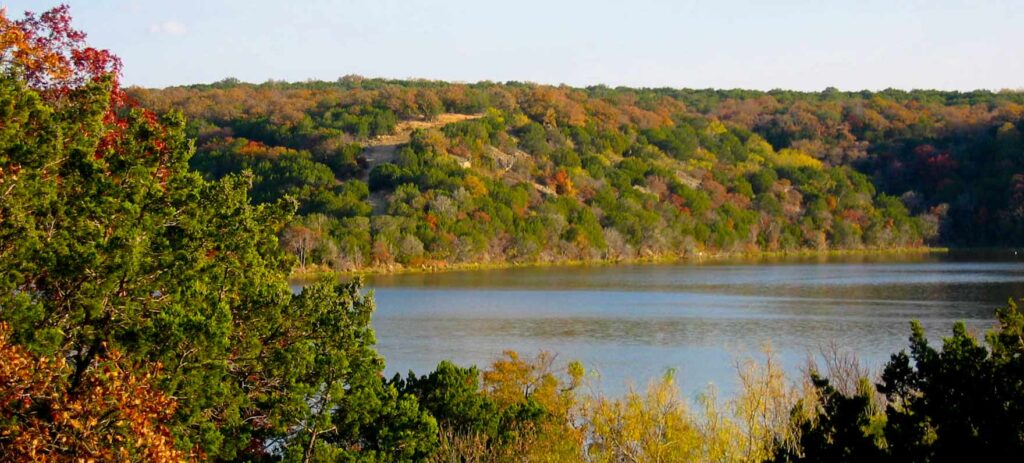
A lake and green, orange, red, and yellow trees.
Courtesy of TPW

Every good park needs a centerpiece, and Tucker Lake is Palo Pinto Mountains’ crown jewel. The 90-acre lake’s quaint charm began as a water source for Strawn — a nearby town — in the 1930s, constructed by the Works Progress Administration. Residents of Strawn reveled in their newfound aquatic escape and were granted leases by the city for surrounding land. Soon after,  they built cabins around the lake and created the Strawn Recreation Club. The club persisted until the 1980s when Strawn’s city council chose not to renew leases. But Strawn and other nearby communities are ready to return to their beloved lake.

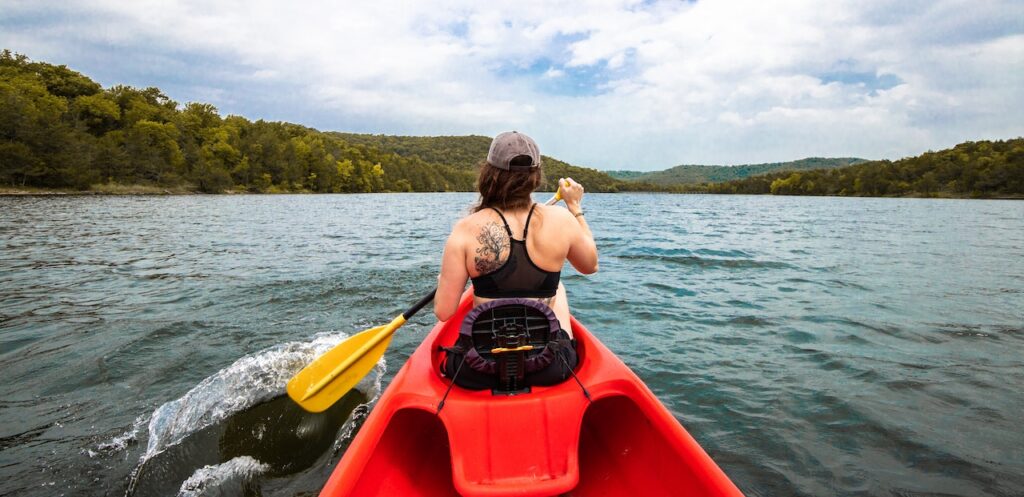
Palo Pinto Mountain State Park’s headquarters is currently under construction near the lake. Motorboats are not permitted for usage, but kayaks will likely be available for rent.  From these kayaks, anglers will have the best, quiet spot to fish for sunfish, bass, bluegill, and others. Texas Parks and Wildlife (TPW) currently studies fish populations at the lake.

Amenities

Woman in a Kayak on a Lake; treese and hills in the background
Courtesy of Brooke Lewis

The park is still under construction, but expect it to be filled with interconnected trails, campsites, and more! The administration carved out at least 18 miles worth of hiking and biking trails that take visitors on a wild, rural adventure. In addition, TPW plans for 59 campsites throughout the property, and some offer primitive camping. For a truly Western experience, some trails and campsites come equipped to handle horseback riding and lodging.

Outside the rugged terrain and trails, amenities include bathhouses, pavilions, children’s play areas, and no-water restrooms. On Tucker Lake, a boat ramp and floating dock will be available for kayaks, and visitors can swim and fish in the tranquil waters.

When Will It Be Ready & Strawn’s Contribution

Courtesy of TPW

Palo Pinto Mountains State Park is expected to open in late 2023 or early 2024. Constructing a park, let alone a state park in the wilderness, is a much more arduous task than many might assume. For example, TPW bought the bulk of the property, more than 3,300 acres, in 2011, and those grounds have been in development since.

The nearby city of Strawn has been a pillar of stability for the park’s construction and donated 120 acres to its formation. In addition, through fund-raising efforts, community members created the Palo Pinto Mountains State Park Partners — a non-profit group to support the park. Residents of Strawn and the surrounding areas, particularly Mineral Wells, hope this and other projects will revitalize the region. And when the park opens, the entrance road will be in Strawn.

A slice of the hill country, Palo Pinto Mountains State Park is here to put the area back on the map!

Despite that almost 90 percent of Texans now live in urban locations, this welcome natural paradise expects to draw 75,000–100,000 visitors annually.

The name of the lake at Palo Pinto Mountains State Park is called Tucker Lake.

Tucker Lake has sunfish, bass, bluegill, and more!

Palo Pinto Mountains State Park will have hiking and biking trails, trails for riding horses, bathhouses, pavilions, a boat ramp, a floating dock, and kayaks for rent.

The nearby city of Strawn has been a pillar of stability for the park’s construction and donated 120 acres to its formation.

The Baker Hotel Restoration

Front façade of Baker Hotel
Photo Courtesy of The Dallas Morning News

The Baker Hotel in Mineral Wells, Texas, is undergoing a restoration.

  • Ongoing Restoration
  • History of The Baker Hotel
  • In Its Heyday
  • Decline and Rebirth

Since opening its doors in 1929, The Baker Hotel, southeast of Possum Kingdom Lake, has been the “ grand old lady”  of Mineral Wells, TX — and she’s about to get a facelift. The hotel has long been a symbol of status and wealth but has remained dormant since the 1970s; however, after a 2014 governmental measure, up to $4 million from tax revenue for Mineral Wells will go towards the $65 million project of restoring The Baker Hotel. 

The project involves Mineral Wells citizens and several investors, including Lair Fairchild of Dallas-Fort Worth. Much of the building’s original design and architecture is to be maintained and updated, such as the luxury mineral spa. In addition, the hotel’s original 450 rooms will be reduced to 165 but with enlarged space.

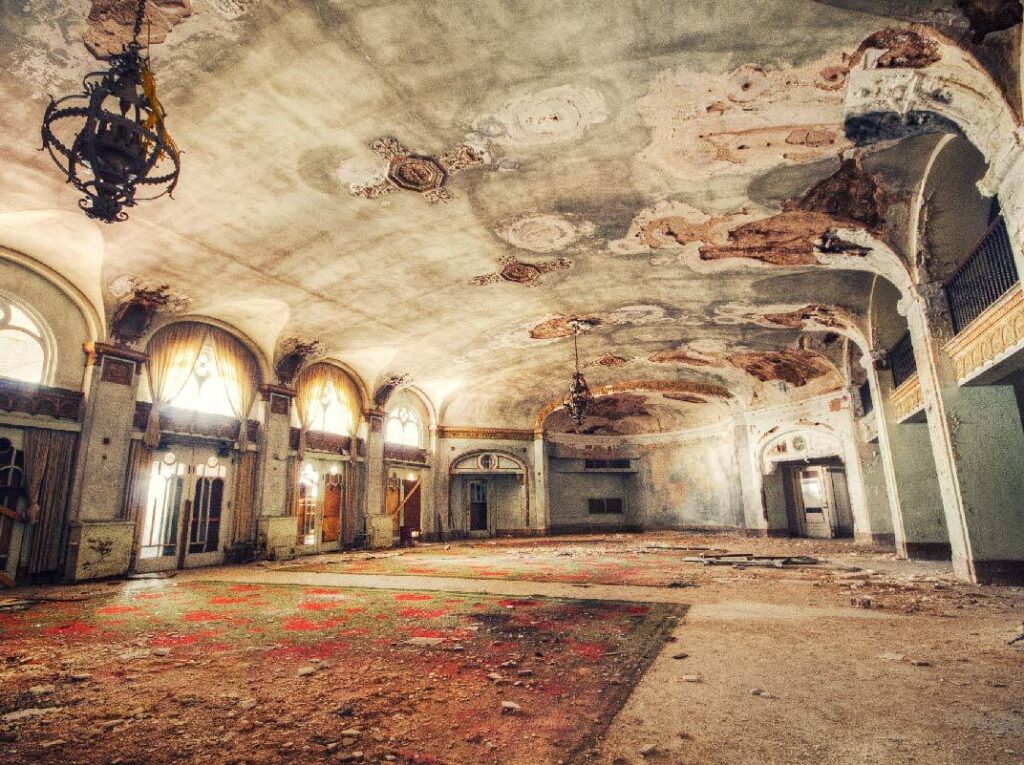
Old ballroom in Baker Hotel
Photo Courtesy of Hunter Chase Development Partners

Project manager Mark Rawlings oversees the hotel’s restoration and reports that the changes are quite noticeable. The hotel expects to reopen its doors in 2024 after more than 50 years. A journey through these hallways, steam rooms, and ballrooms enchants and entices visitors from the past and present, and the future of The Baker Hotel never looked brighter.

The Hope of Mineral Wells

Black and White photo of Baker Hotel
Photo Courtesy of UTA Libraries

In 1922, citizens of Mineral Wells worried that outside powers and individuals were profiting and exploiting the town’s famed mineral waters and collected $150,000 to construct a grand hotel. The idea was that the residents of Mineral Wells should be the primary beneficiaries of the town’s resources instead of corporations. 

Their appeals found their way to Theodore Brasher Baker, a prominent hotelier in Dallas and Fort Worth, and for whom the hotel would ultimately be named.

The Baker’s architect, Wyatt C. Hedrick, took inspiration from hotels in Hot Springs, Arkansas — another city famed for its waters — when developing the lavish resort. Construction on the property began in 1926 but halted abruptly after a business trip to California, where he saw, for the first time, a hotel with a swimming pool. Instantly, the plans for The Baker Hotel changed dramatically. As a result, the finished property received honorable recognition as the first hotel in Texas with a swimming pool. An unparalleled extravagance, the Olympic-sized pool sparkled with the healing mineral waters for which the area is known.

With 14 stories, 450 rooms, several ballrooms, a gym, a salon, a spa, and even a bowling alley, the hotel opened in 1929. The 180-foot behemoth quickly became the town’s iconic landmark and is still the tallest building in Mineral Wells today.

Celebrity Endorsement

Judy Garland checks in to Baker Hotel
Judy Garland checking in to The Baker Hotel Courtesy of judygarlandnews.com

In the 1930s, The Baker Hotel was a wildly lucrative hotbed for the famous, infamous, wealthy, and powerful. The hotel boasted numerous one-of-a-kind amenities such as on-demand ice water, doors that control room electronics, and valet laundry services that allowed guests to drop off dirty linens in privacy. Not only was The Baker Hotel the first in Texas with a pool, but by the 1940s, it would become the first Texas hotel with air conditioning.

Many celebrities and politicians frequented The Baker Hotel, including “King of Hollywood” Clark Gable, musician Lawrence Welk, actress and singer Judy Garland, and even President Lyndon B. Johnson. Rumor has it that the infamous duo Bonnie and Clyde stayed a few nights at the hotel.

Just before World War II, Camp Wolters opened northeast of Mineral Wells and was, at one point, the United States’ largest infantry replacement training center. The base provided the hotel with another boom in business. Mineral Wells’ population wavered around 30,000—measured between the lines of permanent and temporary—with many calling The Baker home.

Decline and Rebirth

View from Cloud Room
Cloud Room Courtesy of TexasMonthly

With the advent of new medicinal avenues, such as antibiotics like penicillin, the hotel’s popularity began to decline. Camp Wolters ceased operations in 1946, but the camp renewed in the form of Fort Wolters in 1951 as a training base for helicopters. It would go on to host conventions for the Texas Republican Party and Texas Democratic Party but paled in comparison to the glory of its heyday. The doors of the historic Baker Hotel shut in 1963, saw a brief renaissance in 1965, but closed again in 1972. The building remained abandoned — and the subject of much paranormal investigating — until 2019.

There’s still a long way to go until The Baker Hotel emerges from its facelift cocoon, but many have waited and invested patiently for this butterfly to take flight once again.

The Baker Hotel first opened in 1929.

Baker Hotel is in Mineral Wells, TX.

Baker Hotel is expected to reopen 2024-2025.

Baker Hotel was the first hotel in Texas to have air conditioning, and the first to have a pool. The hotel was frequented by many celebrities and politicians.

The last time that Baker Hotel closed its doors was in 1972.

The Baker Hotel restoration project is expected to cost at least, if not more, than $65 million.

The project manager for the Baker Hotel restoration is Mark Rawlings.